








There are many resources available to help us understand Adlai's life, words, and work. These include primary sources, secondary sources, and interpretations.
Primary Sources* are like clues that help us discover what things were like in the past, and how and why things have changed over time. Examples include letters, recorded speeches, photographs, newsreels, and diaries.
Secondary Sources* are accounts written after the event, based on primary sources or other secondary sources. Examples include history books, textbooks and biographies.
When historians read and examine both primary and secondary sources, they apply their knowledge of history to analyze and interpret these sources. Historians consider what else was going on at the time an event took place. What were the predominant influences? Has something similar ever happened before? History interpretations can be found in many places, such as museum exhibits, movies, plays, websites, books, magazines, and newspapers. A search for Adlai Stevenson or another history keyword in Today's News demonstrates how news articles and editorials ("opinion" articles) are resources that come into existence on a daily basis.
Explore the following resources. Some include primary sources. Some are secondary sources. Some, like Google's Blog Search, can help you find hotly debated interpretations and highly political opinions. You may even want to post some of your own!
 |
Online Resources | |
|
Books |
Primary sources*
Primary sources (also called "original sources") are the records or traces of past events — documents and artifacts saved from earlier times — from which historians gather information for their research. The name "primary" means that document or artifact was present "at the beginning," at the original time the event or circumstances took place.
Accurate historical research begins with a careful reading or examination of primary sources.
Questions for thought:
The use of primary sources relates well to Adlai Stevenson's core value of trusting people to THINK for themselves: "Trust the people, trust their good sense... Trust them with the facts...."
Check the facts for yourself. Find some clues in primary sources: Read a speech. Look at a photograph. What does it tell you about the past? How can it help you understand the present?
Primary sources (also called "original sources") are the records or traces of past events — documents and artifacts saved from earlier times — from which historians gather information for their research. The name "primary" means that document or artifact was present "at the beginning," at the original time the event or circumstances took place.
Accurate historical research begins with a careful reading or examination of primary sources.
Questions for thought:
The use of primary sources relates well to Adlai Stevenson's core value of trusting people to THINK for themselves: "Trust the people, trust their good sense... Trust them with the facts...."
Check the facts for yourself. Find some clues in primary sources: Read a speech. Look at a photograph. What does it tell you about the past? How can it help you understand the present?
Secondary sources*
A secondary source is a document or recording that discusses information originally presented elsewhere. A secondary source contrasts with a primary source — an original source of the information being discussed. Secondary sources often involve generalization, analysis, synthesis, interpretation, or evaluation of primary source information.
Historians classify the sources of historical writing to help determine the reliability and independence of a source. Since a secondary source is a record or statement made after an event, the fallibility of memory can be an important factor. Shifts in public opinion and personal bias can also affect secondary sources, even for eye-witness accounts written long after an event. Thus many historians would advise that you "proceed with caution" when using secondary sources.
Questions for thought:
Is a newspaper article a primary or a secondary source? Why?
A secondary source is a document or recording that discusses information originally presented elsewhere. A secondary source contrasts with a primary source — an original source of the information being discussed. Secondary sources often involve generalization, analysis, synthesis, interpretation, or evaluation of primary source information.
Historians classify the sources of historical writing to help determine the reliability and independence of a source. Since a secondary source is a record or statement made after an event, the fallibility of memory can be an important factor. Shifts in public opinion and personal bias can also affect secondary sources, even for eye-witness accounts written long after an event. Thus many historians would advise that you "proceed with caution" when using secondary sources.
Examples: encyclopedia entries, research papers, monographs, biographies, history books and textbooks, movies, and plays.
Questions for thought:
Is a newspaper article a primary or a secondary source? Why?
Studying Artifacts and Documents:
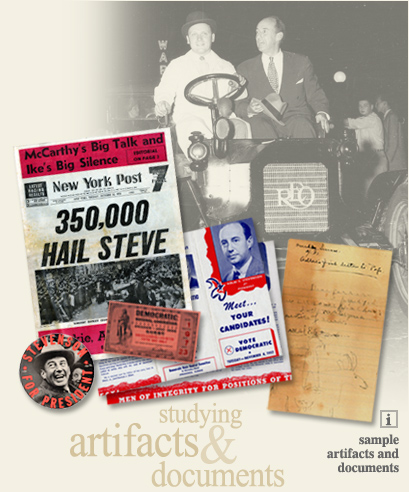
Primary source documents are documents that have been printed, handwritten, recorded, or digitized. They include letters, diaries, ledgers, recordings of speeches, newsreels, newspapers and photographs.
Primary source artifacts are any type of object from the time period, event, or circumstance: campaign buttons, clothing, household items, even buildings.
An organized collection of primary sources on a particular subject is called an archive.
Click on the images in the collage to examine some sample digitized primary source documents and artifacts that relate to Adlai Stevenson (courtesy of the McLean County Museum of History archives).
Primary source documents are documents that have been printed, handwritten, recorded, or digitized. They include letters, diaries, ledgers, recordings of speeches, newsreels, newspapers and photographs.
Primary source artifacts are any type of object from the time period, event, or circumstance: campaign buttons, clothing, household items, even buildings.
An organized collection of primary sources on a particular subject is called an archive.
Click on the images in the collage to examine some sample digitized primary source documents and artifacts that relate to Adlai Stevenson (courtesy of the McLean County Museum of History archives).