"The costliest blunders have been made by dictators who did not quite understand
the working of real democracy and who mistook diversity for disunity."
"The art of government has grown from its seeds in the tiny city-states of
Greece to become the political mode of half the world. So let us dream of a
world in which all states, great and small, work together for the peaceful
flowering of the republic of man."
—June 17, 1965 speech at Harvard University
"The goal of life is more than material advance; it is now and through all eternity, the triumph of spirit over matter, of love and liberty over force and violence."
"If total isolationism is no answer, total interventionism is no answer, either. In fact, the clear, quick, definable, measurable answers are ruled out. In this twilight of power, there is no quick path to a convenient light switch."
—June 17, 1965 speech at Harvard University
"We cannot be any stronger in our foreign policy — for all the bombs and guns
we may heap up in our arsenals — than we are in the spirit which rules inside
the country. Foreign policy, like a river, cannot rise above its source."
"Nature is neutral. Man has wrested from nature the power to make the world
a desert or to make the deserts bloom. There is no evil in the atom; only in
men's souls."
—September 18, 1952 speech at Hartford, Connecticut
"When an American says that he loves his country, he...means that he loves an
inner air, an inner light in which freedom lives and in which a man can draw
the breath of self-respect."
—August 27, 1952 speech at New York City, New York
"This must be the context of our thinking — the context of human interdependence
in the face of vast new dimensions of our science and our discovery...the awful
majesty of outer space.
—July 9, 1965 speech in Geneva, Switzerland
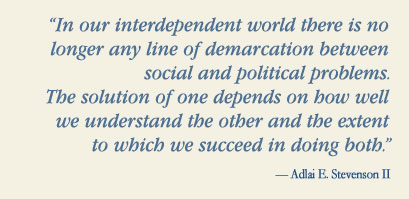
"In our interdependent world there is no longer any line of demarcation between
social and political problems. The solution of one depends on how well we understand
the other and the extent to which we succeed in doing both."
"We doubt whether any nation has so absolute a grip on absolute truth that
it is entitled to impose its idea of what is right on others."
"There is nothing to fear in difference; this is in fact one of the healthiest
and most invigorating of human characteristics without which life would become
lifeless."
In a controversial speech Stevenson calls for an international nuclear test
ban because it would announce our peaceful intentions and be, "...a step which
would reaffirm our purpose to act with humility and a decent concern for world
opinion."
—April 21, 1956
"The search for peace will not end, it will begin, with the halting of these
[nuclear] tests. What we will accomplish is a new beginning, and the world
needs nothing so much as a new beginning. People everywhere are waiting for
the United States to take once more the leadership for peace and civilization.
We must regain the moral respect we once had and which our stubborn, self-righteous
rigidity has nearly lost.... I have no right to stand silent: I owe it to you
to express my views, whatever the consequences."
—October 15, 1956 nationwide television broadcast
"We travel together, passengers on a little spaceship, dependent upon its
vulnerable reserve of air and soil; all committed for our safety to its security
and peace; preserved from annihilation by the care, the work, and I will say,
the love we give our fragile craft. We cannot maintain it, half fortunate,
half miserable, half confident, half despairing, half slave — to the ancient
enemies of mankind — half free in the liberation of resources undreamed of
until this day. No craft, no crew, can travel safely with such vast contradictions.
On their resolutions depends the survival of us all."
—July 9, 1965, Stevenson's last speech given to UN Economic and Social Council
February 5, 1944, in a report on war-torn Italy for Foreign Economic Administration,
prefiguring the Marshall Plan, Stevenson observes that the "...United States
has obvious long-range interests in developing the climate of enduring peace
in Europe ...on a sound economic foundation."
February to April of 1960, Stevenson travels throughout Latin American and
observes that, "in a region rich in resources half the people are hungry, half
don't sleep in beds, half are illiterate...if they don't achieve their desire
for a better economic and political life, we may find enemies and not friends
on our doorstep."
"We will not lose faith in the United Nations. We see it as a living thing
and we will work and pray for its full growth and development. We want it to
become what it was intended to be — a world society of nations under law, not
merely law backed by force, but backed by justice and popular consent. We believe
the answer to world war can only be world law. This is our hope and our commitment...."
—October 24, 1952 campaign radio address for United Nations Day
Friends challenged Adlai's stand on the need for American engagement in Europe,
which was tottering under the pressures of German, Italian and Spanish Fascism.
He was accused of "Trying to kill our sons." Stevenson was later to assert — "I
was only trying to save their sons, ...I was convinced that aide to Britain was
the only way to stay out of the war."